Tattoo-Friendly Onsen Japan: The Complete Guide for Tattooed Travelers
By Emi Kato, Onsen Specialist and Japan Travel Writer
Two women stared at the floor of the changing room while the attendant quietly refunded my entry fee. I had read the sign, ignored it, and walked into the men's bath at a small sento outside Hakone with a full back piece on full display. The attendant did not shout. He simply stepped into the changing room, asked me to come back outside, and explained the policy with the patient voice of someone who has had this conversation a hundred times.
That was 2009. Since then I have visited more than ninety onsen across Japan, kept a running spreadsheet of door policies, and learned, slowly, where a tattooed body is welcome, where it will be tolerated with the right preparation, and where the answer is a polite no regardless of what you say. This guide is that spreadsheet, rewritten as plain English for tattooed travelers planning a Japan trip.
If you want the short version: book tours at properties that explicitly say tattoo-friendly, carry a roll of waterproof flesh-toned tape for everything else, and reserve a kashikiri buro (private bath) at any ryokan where the shared bath rule makes you nervous. The three tours below — in Tokyo, Kyoto, and Shinjuku — are run by operators who handle the etiquette and the entry so you can focus on the water.
Why the rule exists in the first place
Onsen tattoo policy is not about hygiene. It has never been about hygiene. The rule traces to the post-war period, when visible tattoos carried an explicit association with organized crime in Japan. Bathhouse owners posted signs and refused entry to keep yakuza out of the shared bath, and the rule stuck for decades after the original social context faded. Today the person being turned away is far more likely to be a German backpacker with a forearm piece or a Brazilian visitor with a floral half-sleeve than anyone connected to a syndicate. Most attendants know this. Few have the authority to waive the rule on the spot.
Understanding this history changes how you read every sign on every door. The laminated notice is institutional, not legal. It is enforced unevenly. It is changing, slowly, at the properties that actively court international guests. The policy is not yours to overturn at the counter. It is yours to navigate around with a bit of planning.
The three tiers: Welcome, Tolerated, Restricted
Sorting any onsen into one of three tiers before you arrive is the single most useful thing you can do for a tattooed trip. Every property I have visited falls cleanly into one of these buckets.
Welcome. The property says, in writing, that tattoos are fine. No cover, no negotiation, no anxiety. The list is shorter than it should be and growing every year. Funaoka Onsen in Kyoto, Matsunosuke in Tokyo, and a handful of Hokkaido properties are in this tier today.
Tolerated. Tattoos are allowed if covered with waterproof tape, and the unspoken rule is that you do not ask at the counter. Asking forces the attendant to say no. Arriving with a small piece under a patch, behaving normally, and drawing no attention is the entire game in this tier. The number of Tolerated properties is the largest of the three.
Restricted. No exceptions, no matter the size of the piece. Large signs, strict staff, often municipal facilities or high-end ryokan with a fixed corporate policy. Do not try to negotiate at the door. Book a private bath, choose a different property, or skip the shared bath on that visit.
A regional map for tattooed travelers
This is not exhaustive. Policies change, and individual properties within each region vary. But these are places I have personally visited or verified recently, grouped by region.
Tokyo
The single best city in Japan for tattooed travelers. The capital has more openly tattoo-friendly facilities than anywhere else in the country, partly because so many properties compete for international visitors and partly because the staff at long-running sento have simply become used to tattooed guests. Matsunosuke in Shibuya is welcome-tier; Hoshinoya Tokyo is welcome-tier; the Tokyo trips listed below are run by operators who explicitly market to tattooed guests.
Kyoto
Funaoka Onsen, in the northern part of the city, has been openly tattoo-friendly for years. It is a beautifully kept Taisho-era bathhouse, the kind of place you would visit for the architecture alone, and the staff treat tattooed guests as a normal part of the day. Shimogamo no yu is tolerated-tier; bring cover tape for small pieces. The Kyoto tour below pairs Funaoka with a guide who handles the etiquette end-to-end.
Hakone
Mixed, with more openly tattoo-friendly properties than most regions. Yama no Chaya is tolerated and provides stickers at the door. Tenzan Toji Kyon is welcome. Yumoto Fujiya is restricted; if you want the Fujiya experience, book a kashikiri buro.
Beppu and southern Kyushu
Beppu's eight distinct hot spring areas (the Beppu Hatto) are mostly tolerated with cover. Myoban Yunosato is welcome-tier and the milky mineral water is some of the best in the country. Takegawara is mixed and depends on the staff on duty; treat it as tolerated at best.
Towns to plan around: Kinosaki, Nyuto, Ginzan
These are the historic onsen towns that international visitors love, and they are also the towns where tattoo policy is most strictly enforced. Public baths at Kinosaki's sotoyu (seven external bathhouses) are restricted. Nyuto's Tsuru no yu is restricted. Ginzan Onsen's ryokan baths are mostly restricted. Private baths are the right call in all three. Plan around the rule rather than against it.
Kashikiri buro: the private bath
The nuclear option, in the best sense. You rent a bath by the hour, usually 2,000 to 4,000 yen, and the door locks behind you. No one sees your body. No one cares about your body. The water comes from the same spring source as the public bath, often the same physical pipe. If you have a large visible tattoo and zero appetite for conversation, a kashikiri buro is the right call.
The tradeoff is honest. Part of what makes onsen culture worth the trip happens in the shared bath: the quiet, the strangers, the sense of a communal ritual older than any of us. A private bath gives up that communal dimension. It gives you the water, the heat, the mineral smell, and complete peace of mind, and on a trip where you want to soak without rehearsing a speech in your head, that is often exactly the right trade. Most ryokan list kashikiri slots on the booking page or take reservations at check-in. If yours does not advertise one, ask. More properties offer private baths than say so publicly.
Cover patches: what actually works
The single method I trust is waterproof, flesh-toned or matte-black sports tape. The Yakushimado brand is the one I keep in my bag, sold at Tokyu Hands, Don Quijote, and most large drugstores. A 10 cm by 5 m roll costs about ¥800 and covers a surprising amount over a trip. Cut strips to the shape of the piece, press them down firmly on dry skin before you enter the changing room, and smooth the edges so nothing lifts in the bath. For anything larger than a palm, layer strips with a slight overlap rather than stretching one piece across the design.
People often ask about waterproof foundation sticks. Skip them. Liquid makeup does not survive a 42-degree sulphur bath. It streaks, it clouds the water, and it draws exactly the attention you are trying to avoid. Tape is the only method I trust in hot mineral water, and even then I keep my time in the deepest, hottest pools short, since heat softens the adhesive.
Three tattoo-friendly tours worth booking
If you want the reassurance of someone who already knows the door policy, a guided experience removes the single biggest source of stress: not knowing until you are undressed. These three are run by operators who explicitly welcome tattooed travelers and who handle the etiquette so you can simply soak.
Tattoo-Friendly Open-Air Onsen & Drink (Tokyo)
Affiliate disclosure: This site contains affiliate links. We may earn a commission when you book through our Viator links (PID=P00299531), at no extra cost to you.
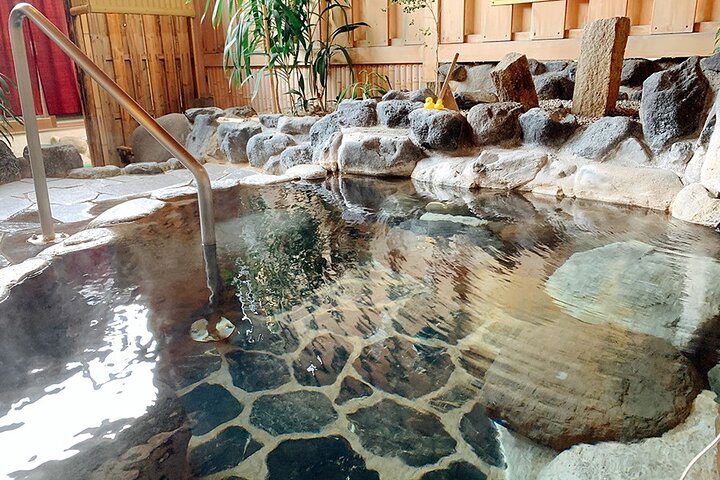
A rotemburo open-air bath in central Tokyo that explicitly allows visible tattoos, paired with a drink service in a relaxed setting. The simplest possible answer to the tattoo question in the capital: book, arrive, soak, no conversation required. Best for first-time visitors who want Tokyo onsen without the policy homework.
External booking on Viator · pricing and cancellations handled by Viator
Tattoo-Friendly Bathing Culture Tour at Funaoka Onsen (Kyoto)
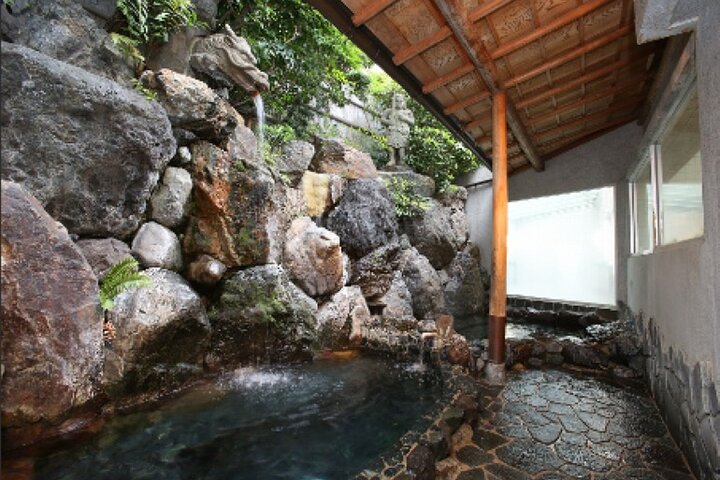
A guided visit to Funaoka Onsen, a Taisho-era bathhouse in northern Kyoto that has been openly tattoo-friendly for years. The guide handles entry, explains Japanese bathing etiquette in plain English, and stays for questions. Best for travelers who want the cultural context along with the soak, and who want to learn why a bathhouse like Funaoka matters in Kyoto's daily life.
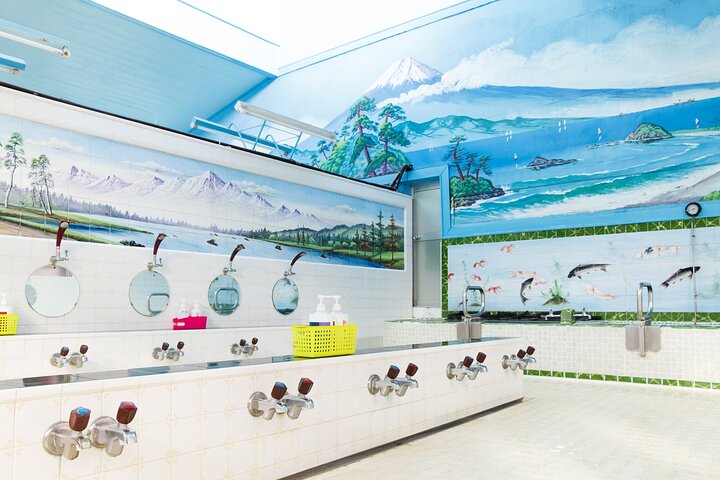
An accessible, central-Tokyo authentic onsen visit in Shinjuku that explicitly welcomes tattooed guests. Short on time but want a real onsen? This is the right pick. No hike, no long transfer, no guesswork at the door. Best for travelers on a tight Tokyo schedule who want one clean, verified soak.
External booking on Viator · pricing and cancellations handled by Viator
A short script for the front desk
If you do arrive at a property whose policy is not on the website, the only sentence that helps is short, polite, and in Japanese if you can manage it. Sumimasen, ire-zu wa ari masen ka? ("Excuse me, may I enter with tattoos?") spoken calmly, with the cover tape already applied and ready to show, gets a yes more often than not at Tolerated-tier properties. The phrase you should never use is any version of "but I am a foreigner" or "but tattoos are normal in my country." That line will close doors. Cultural context travels poorly. A polite question, with tape in hand, opens them.
If the answer is no, accept it without argument. Walking out and finding another property keeps the staff's respect for the next tattooed guest who walks in politely. Blowing up at the counter does the opposite.
Planning a Japan trip with tattoos
Three rules that cover almost every trip. First, book a ryokan with a kashikiri buro for the first stay in any new onsen town. You learn the rhythms in private, then decide how aggressive you want to be with public baths later. Second, use the tattoo-friendly lists on this site for day visits, and treat anything not on the list as restricted until you have confirmed otherwise. Third, carry a small pack of waterproof cover tape at all times. It weighs nothing, fits in a coin pocket, and has saved more than one of my trips.
The policy is changing, just not evenly. Every year a few more properties move from Restricted to Tolerated, and a few more from Tolerated to Welcome, often quietly and without a press release. The tape in my bag gets used less than it did in 2009. That is real progress, and it is worth being patient for.
Frequently asked
Can I be turned away from a public bath for having a tattoo?
Yes, at properties whose posted policy says so. It is legal for the bath to refuse entry. The recourse is to choose a different property, or to book a private bath at the same place.
Do small tattoos also get refused?
Yes, even a small visible piece can trigger a refusal at restricted properties. Policy is usually binary, not size-based.
Is there a national list of tattoo-friendly onsen?
No official list exists. The Japan Onsen Association publishes facility standards but does not track door policies. Independent lists like this one are the practical resource.
Can I use a private bath at any ryokan?
Most ryokan offer kashikiri buro by reservation. Confirm at booking. Some luxury properties include private in-room baths with the stay.
Will the tattoo policy change while I am in Japan?
It can. Always confirm by phone or email with the property the day before you visit, especially at smaller sento and family-run bathhouses.