Onsen vs sento: the legal line you keep hearing about
Travel guides throw these two words around like they are synonyms I recommend booking the Tattoo-Friendly Japanese Bathing Culture Tour At Funaoka Onsen.. They are not. The Japanese Hot Spring Law, Onsen-hō, says that for a bath to be called an onsen the water has to come from a natural geothermal source and contain a minimum level of dissolved minerals. The exact threshold is technical, but the practical point is simple: an onsen is defined by where the water comes from, not by the building around it.
t.A sento, on the other hand, is a public bathhouse that heats ordinary tap water for communal use. Sento have existed for centuries because most Japanese homes did not have private baths until the second half of the 20th century. They are neighbourhood institutions, often beautifully tiled, almost always cheap, and historically run by families for several generations. The sento in Nagoya that turned me away in 2016 was exactly this kind of place. I hold no grudge. The staff were polite and the refund was immediate. The rule was just the rule.
The interesting wrinkle in 2026 is that a growing number of Tokyo sento now pipe in real onsen water from Hakone, Kusatsu, and other source regions. Some have a small sign at the entrance. Most do not. If the water feels softer than tap water, smells faintly mineral, and leaves a faint residue on the tub, you are probably bathing in onsen water at sento prices. This is one of the best deals in Japanese bathing and almost nobody outside the neighbourhoods knows about it.
Rotemburo: the outdoor bath you came for
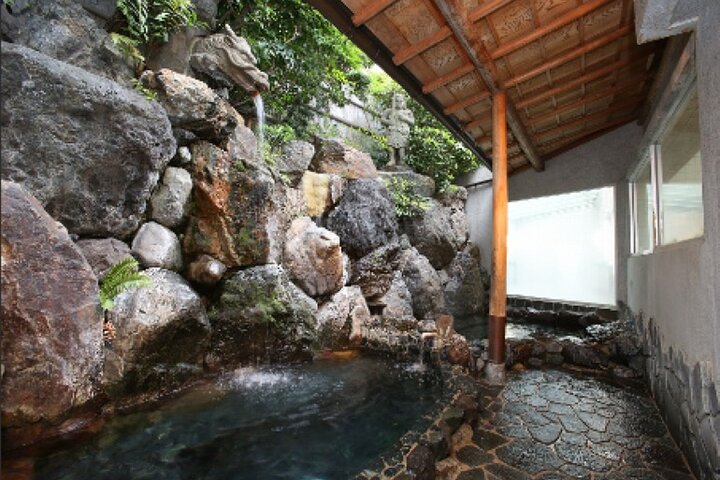
Rotemburo, sometimes romanised as rotenburo, means an outdoor hot spring bath. It is the experience most travellers picture when they book a trip to a hot spring town: a wooden tub, mountain air, steam rising against a dark sky, and the rest of the world temporarily dissolved.
The best time of year for a rotemburo is winter in snow country. I am not being poetic. There is something about hot mineral water against cold air that the body reads as better than either temperature alone. Nozawa Onsen in Nagano, Zao Onsen in Yamagata, and the outdoor baths at many Hakone ryokan are all strong choices. If you have ever considered flying to Japan in February specifically to sit in a hot pool while snow falls on your head, this paragraph is your permission slip.
Summer rotemburo are also good, but the trade-off is mosquitoes at dusk and the occasional frog. Most facilities empty and refill the outdoor bath once a day in the morning, so if you want the freshest water, arrive at opening time.
Kashikiri buro: the private bath that solves three problems at once
Kashikiri buro, literally a reserved or private bath, is the single most useful thing in the Japanese bathing system for first-time visitors, tattooed travellers, and anyone who feels shy about undressing with strangers. You book the bath for a set window, usually 45 to 60 minutes, and the tub is yours alone or with whoever you brought in.
Three problems it solves in one move. First, tattoo restrictions. Most ryokan and many onsen hotels apply their tattoo policy only to the shared bath. The kashikiri buro is treated as a private booking, so visible ink is fine. Second, shared bathing anxiety. If you have never been naked in a public space before, jumping straight into a 20-person tub is a lot. A private bath lets you learn the rhythm of wash, soak, rinse, repeat without an audience. Third, language barrier. The booking is in advance, the staff point at the room, and you can take your time. No pointing at bottles asking which one is shampoo.
You usually book at the front desk on arrival, and the busiest times get taken fast. If you know you want one, ask at check-in before you do anything else. Some properties now let you reserve online when you book the room.
The four water types worth knowing
The water itself is the whole point. The minerals dissolved in it change how the bath feels, how it smells, and what it supposedly does to your skin. Claims about healing are mostly folklore. The sensory difference is real. Here is what you will actually notice.
Sulphur onsen
The smell hits you before you see the bath. Sulphur, or io, water smells like boiled eggs and the yellow residue it leaves on the tub walls can stain your towel. Many people love it for the smell alone, and it is widely considered good for skin conditions. Kusatsu and Noboribetsu are famous for it. If you have asthma, take it easy. The vapour can irritate lungs at high concentration.
Iron onsen
Iron-rich water, tecchūsen, runs clear when it comes out of the ground and turns rust-orange within hours as the iron oxidises. Some baths refill only once a day, so the afternoon soak in a traditional iron onsen is genuinely orange. It feels silky, is said to help with iron deficiency, and will permanently stain anything white you leave in the water. Do not bring your best towel.
Sodium chloride onsen
Salt water, enka, has a higher specific heat than plain water, which means your body holds the warmth longer. The bath does not need to be hotter for you to feel warmer in it. Your skin will taste faintly of salt when you get out, and you will still feel warm two hours later. My favourite water type. The heat stays with you for hours after, and that is the part nobody tells you before you try it. Excellent in cold weather.
Simple alkaline onsen
Simple alkaline, simple alkalescent or tansei-ka, has a pH above 7.5 and very little dissolved mineral content beyond the alkalinity itself. It feels slippery on the skin, almost soapy, and is the closest most people get to bathing in soft water. Gentle, clean, and the most common type in day-trip onsen near major cities.
Bathing etiquette, in the order you will do it
You will see signage at every bath explaining the rules. Most of it boils down to four habits. First, wash and rinse thoroughly at the seated shower stations before you enter the tub. Soap, shampoo, rinse, and only then step in. The tub is for soaking, not for washing. Second, no swimsuits. Nudity is the norm in shared baths and anything else draws attention. Third, do not put your small towel in the water. Fold it on your head, set it on the side of the tub, or place it on the bath rim. The head placement is a tradition, not a rule, and it keeps your hands free. Fourth, long hair should be tied up so it does not trail in the water.
These are not suggestions. The first time I watched a tourist get pulled aside by an elderly regular for letting a towel drift into the tub, I understood how seriously people take it. Learn the rhythm. Once you have done it once, the rest of your life of bathing in Japan is easy.
The quietest hours, and why morning matters
If you want silence, go before 9 AM. Most hotels and day baths open at 6 or 7, and the first two or three hours are almost empty. You will share the tub with whoever got up early, which is usually a few older regulars and maybe one other traveller who read the same advice you did. By 10 AM the bus tours have arrived and the bath turns into a social space. By evening the after-work sento crowd is in, and the noise level jumps again.
We earn a commission when you book through our links on Viator (PID P00299531), at no extra cost to you.
For tattooed travellers, morning also tends to be the lowest-risk time to walk through shared facilities. There are fewer eyes on the entry. If you are visiting a sento for the first time and you are not sure how the policy works at that specific branch, the morning visit is the one where I have had the fewest awkward conversations. That is also a good time for the Tattoo-Friendly Japanese Bathing Culture Tour at Funaoka Onsen if you would rather have someone walk you through etiquette the first time.The single most useful thing I can tell you about onsen types is that the categories overlap. A rotemburo can also be a sodium chloride bath. A kashikiri buro can be a sulphur bath. The physical setting, the privacy level, and the water itself are three separate decisions, and the best trips pick a combination that matches the weather, your group, and how tired you are. Once you stop thinking of an onsen visit as a single thing and start treating it as three independent choices, the whole country opens up.
Beppu Private Tour - Onsen Experience in nature
[Hot Spring Experience in Nature + Jigokumushi Steamed Snacks Experience Plan] Enjoy a hot spring experience immersed in the natural environment of a bamboo gro
Check availabilityBeppu Private Tour - Onsen Experience in nature
[Hot Spring Experience in Nature + Jigokumushi Steamed Snacks Experience Plan] Enjoy a hot spring experience immersed in the natural environment of a bamboo gro
Check availabilityBeppu Private Tour - Onsen Experience in nature
[Hot Spring Experience in Nature + Jigokumushi Steamed Snacks Experience Plan] Enjoy a hot spring experience immersed in the natural environment of a bamboo gro
Check availability