Kurokawa Onsen, Kumamoto
Kurokawa Onsen: Japan's Most Beautiful Hot Spring Town
>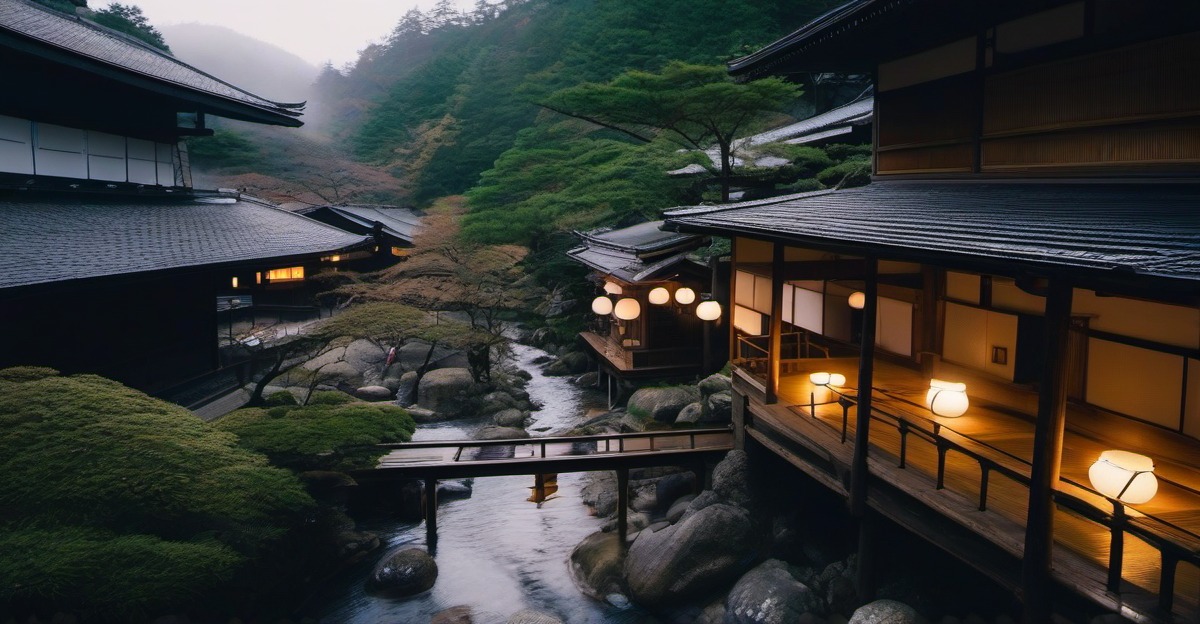
A Kyushu mountain village built around outdoor baths and a wooden bath pass that lets you hop between ryokan in a yukata. The Aso caldera above, the river gorge below, twenty-some ryokan with their own hot spring sources.
We earn a commission when you book through our Viator links, at no extra cost to you.
Why Kurokawa is different
Kurokawa is the most beautiful onsen town in Japan. That is not marketing. Walk through the village at dusk in a yukata with a wooden bath pass around your neck and tell me I am wrong.
The town sits in a steep river gorge on the north rim of the Aso caldera in Kumamoto Prefecture, Kyushu. About twenty ryokan and minshuku line the main walking path, each with its own hot spring source and its own outdoor bath. The architecture is consistent: dark wood, stone paths, paper lanterns, low roofs. There are no convenience stores on the main street. There are no high-rise hotels. There are no tour buses parking in the center. Everything is built to the same scale as everything else, and the scale is human.
This is not a coincidence. Kurokawa nearly collapsed as a destination in the 1990s when the larger Kyushu hot spring towns (Beppu, Yufuin) drew visitors away. The town revived itself through a deliberate design program: ban neon signage, build in cedar and stone, encourage ryokan to develop unique outdoor baths, and create the inyu pass to drive visitors back to walking between properties instead of staying in one. It worked. Kurokawa is now the most written-about onsen town in English-language Japanese travel media, and it earns that attention honestly.
The inyu (湯) pass
The single best thing about Kurokawa is the bath pass. You buy a flat wooden key, shaped roughly like a stylised 湯 character, at the information center in town. Adult price is 1,300 yen (children are 700). The pass is valid at twenty-six member ryokan and one public bath. You take it to three ryokan of your choice during your stay, present it at the front desk, and they let you in to bathe. No reservation. No additional fee. You can also opt for a two-bath (1,000 yen) or five-bath (2,000 yen) variant.
The practical effect: you stay in one ryokan overnight, but you bathe in three. You walk between them in your yukata and geta, the wooden clogs that all ryokan provide. The gorge is short, the entire main path is about 600 metres, and most of the ryokan have baths a five-minute walk apart. By the time you finish the circuit you have bathed in three different springs, each with its own mineral profile, each in a different outdoor setting.
Most visitors do the inyu circuit in this order: arrive at their ryokan mid-afternoon, drop bags, bathe at the ryokan, walk out around 5pm for the second bath at a different property, return for kaiseki dinner, walk out again at 9pm for the third bath when the paths are lit by lanterns and most bathers have gone to bed. That third bath at 9pm in a yukata on a lantern-lit stone path in a mountain gorge is, for my money, the single best hour you can spend in Japan.
Which ryokan
Twenty-six options is too many to enumerate. Three that I have stayed at and recommend specifically:
Yamamizuki has the most architecturally interesting outdoor bath in town: a cedar tub cantilevered out over the river gorge, with the water level of the bath even with the treetops of the opposite slope. The rooms are small but the kaiseki is excellent. Book a room with the bath attached.
Shimoda Onsen has the smallest in-room capacity and the friendliest staff. The outdoor bath is buried in a grove, which means you bathe in near-silence except for birdsong. Less impressive architecture, more intimate atmosphere.
Kurokawa-dori ryokan cluster, there are four or five adjacent ryokan in the center of town with shared access to a public bath complex called Jigoku-Meguri. Worth stopping here even if you are not staying at one of them.
When to go
Kurokawa is a four-season town. Spring (late March to early May) has the surrounding mountains in fresh green and cherry blossoms in the lower village. Summer is hot at the bottom of the gorge, the river gorge provides some breeze, and the open-air bath is welcome in the evening. Autumn (late October to late November) is when the maples turn crimson and the ryokan charge peak prices. Winter (December to February) is my favorite: snow on the rooftops, steam rising from the outdoor baths, the gorge quiet enough to hear the river.
Book ryokan two months ahead for autumn foliage weekends. Walk-in is fine for weeknight stays in any other season. The town has limited capacity (about 2,000 guests across all ryokan) and fills up fast in October.
Getting there
From Kumamoto: highway bus from Kumamoto Station to Kurokawa, 90 minutes, around 2,000 yen one way. There are six to eight departures per day. From Fukuoka (Hakata Station): direct highway bus, three hours, about 3,500 yen one way. From Beppu: drive or take a connecting bus via Aso, two to three hours. There is no train station at Kurokawa. Plan for bus or car.
The drive from Kumamoto through the Aso caldera is one of the great Japanese road trips if you have a car, but most international visitors take the bus. Highway buses have luggage space, depart from the main station, and drop you at the Kurokawa bus terminal which is a three-minute walk from the center of town.
Book a Kyushu Onsen Tour with Kurokawa Stop →
Frequently asked
Is Kurokawa Onsen worth a separate trip from Tokyo?
Yes, if you are serious about onsen as a destination. Kurokawa is a 3-hour flight plus 90-minute bus ride from Tokyo, or a 3-hour bus ride from Fukuoka. The town rewards an overnight stay, ideally two nights, and pairs naturally with Beppu (2 hours by car), Aso caldera (1 hour), and Kumamoto city (1.5 hours).
Can you do Kurokawa as a day trip?
Technically yes, highway bus from Kumamoto arrives around 11am, returns at 5pm. Realistically, no. The point of Kurokawa is the evening bath and the morning bath, both of which require an overnight stay. A day trip misses what makes the town worth visiting.
Is the inyu pass worth it?
Yes. For 1,300 yen you bathe at three ryokan. Even one bath at a similar ryokan would cost 800-1,200 yen on its own. The pass is the deal. The five-bath pass at 2,000 yen is generous and aimed at visitors staying more than one night.
Are Kurokawa ryokan tattoo-friendly?
Most are. The town actively markets itself as tattoo-friendly and the smaller ryokan in particular are happy to accommodate. Confirm with the property when you book. Most have sticker cover options if your tattoo is small enough.
Related: Beppu onsen guide · Onsen etiquette for first-timers · Hakone onsen guide
By Emi Kato, onsen specialist. Twelve years documenting Japan's hot springs from a base in Kyoto. Visited Kurokawa four times, most recently in March 2026. Tattoo policies verified by phone.
Hakone Luxury Onsen Private Tour
Hakone Luxury Onsen Private Tour offers a relaxing full day journey through Hakone's breathtaking natural landscapes, scenic viewpoints, and authentic Japanese
Check availabilityExplore More
Related guides and comparisons: