Nyuto Onsen, Akita
Nyuto Onsen: Snow-Country Hot Springs in Akita
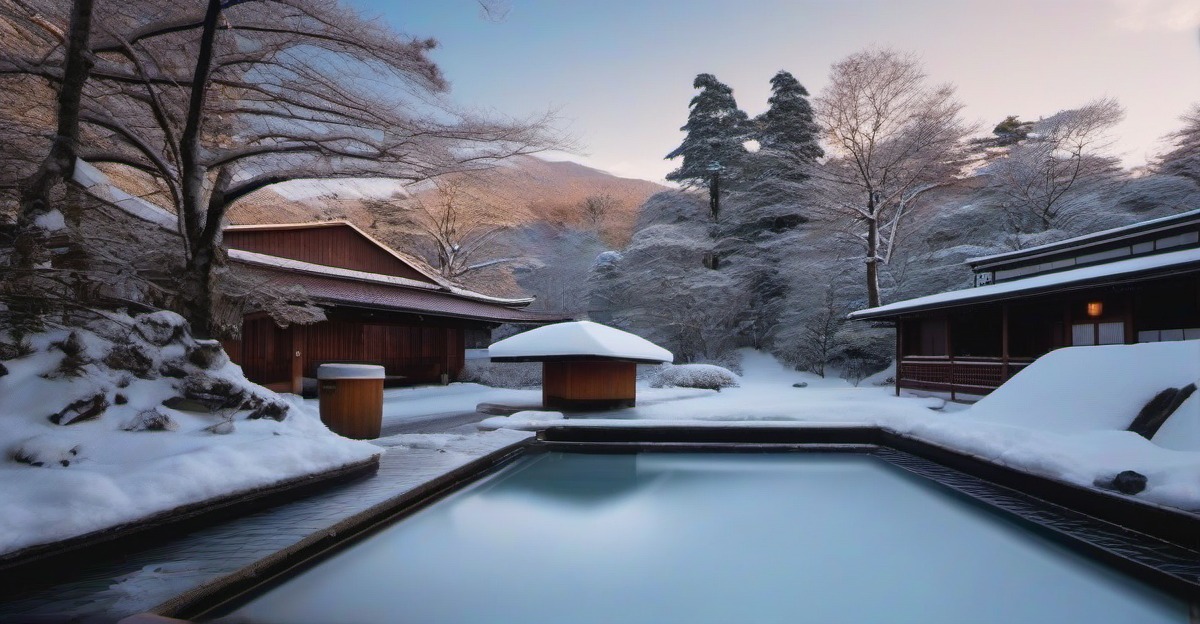
>
A hamlet of seven ryokan in the Akita mountains. Thatched roofs, mixed-gender outdoor baths that are three centuries old, eight metres of snow a year, and steam so thick in February you cannot see the person two metres away from you.
We earn a commission when you book through our Viator links, at no extra cost to you.
What Nyuto actually is
Nyuto Onsen in February: snow up to the eaves, 100-degree water, steam so thick you cannot see the person 2 metres away. The mixed bathing is centuries old and completely practical, the steam is your privacy.
Nyuto is not a town. It is a cluster of seven ryokan in a single river gorge in the mountains of Akita Prefecture, on the eastern edge of Lake Tazawa. The seven properties, Tsurunoyu, Taenoyu, Kuroyu, Magariyoku, Ogama, Shinonome, and Wabukuro, are scattered along a four-kilometre dead-end road that climbs into the beech forests above the gorge. Each ryokan has its own hot spring source, its own outdoor bath, and its own slightly different mineral profile. Day-use entry is allowed at all seven. The Yumeguroro pass (2,500 yen for adults) gives you entry to all of them on a single day.
This is one of the snowiest inhabited places in Japan. The gorge gets roughly eight metres of snowfall per year. Temperatures regularly drop below -10°C in January and February and can hit -20°C during cold snaps. The outdoor baths are uncovered. The water coming out of the source is 95 to 100°C in some properties, cooled to 42 to 45°C by the time it reaches the bath. The contrast between air temperature and water temperature is what Nyuto is actually selling.
The konyoku tradition
Mixed-gender outdoor bathing (konyoku) is the most distinctive thing about Nyuto. Three of the seven ryokan have officially mixed-gender outdoor baths: Tsurunoyu (the main outdoor bath is konyoku), Taenoyu (one of two outdoor baths is konyoku), and Kuroyu (the main rotemburo is konyoku). The practice dates to the Edo period, over 300 years of continuous mixed bathing at Tsurunoyu specifically.
This is not the mixed bathing of a resort hotel pool. There is no swimsuit. The tradition is that everyone bathes nude. The practical mechanism for modesty in winter is the steam itself: at sub-zero temperatures, the steam rising off a 42°C bath is so dense that visibility drops to one or two metres almost immediately. You see a vague shape if a person is very close. That is the privacy. It works because the steam is the privacy. On the rare warm day in summer, when the air is clear and the steam is thin, you wear your small modesty towel over yourself and move on.
For international visitors who have not done this before: it is less awkward than it sounds. The steam really does provide the privacy. Most bathers keep their small towel folded on their head or held in front of themselves. The cultural expectation is to be unselfconscious without being performative. Nobody is staring. Nobody is taking photos. The point is the water, not the social performance. If you arrive uncomfortable, you will leave comfortable, that has been my consistent experience with first-timers at Nyuto.
Which ryokan
Tsurunoyu is the most famous. The original thatched-roof building is from 1638 (the current structure is a 1980s reconstruction of the same design). The main outdoor bath is konyoku and is the image you have seen of Nyuto if you have seen any photograph, a wooden tub filled with steam, surrounded by snow, mountains behind. Stay overnight if you can. The kaiseki uses local Akita ingredients, including hinai-jidori chicken and inaniwa udon. Book three months ahead for winter weekends.
Taenoyu is the most foreigner-friendly. The owner speaks English. The ryokan is smaller and quieter than Tsurunoyu. The mixed outdoor bath is upstream of the building, accessed by a short snowy path, atmospheric in a way the main Tsurunoyu bath is not.
Kuroyu has the most dramatic setting. The ryokan is at the end of the road, the gorge narrows to almost nothing above it, and the outdoor bath sits in a bend of the river with vertical rock walls on three sides. Hot water and sulfur smell. Very winter-focused.
When to go
Winter is the point. December through March, with January and February the peak. Snow is what makes the outdoor bath incomparable. You arrive at the ryokan in snow boots, change into a yukata, walk 30 metres to the outdoor bath in slippers through fresh snow, sit in 42°C water while snow falls on your head and shoulders. The water is hot enough to keep you warm even with snow accumulating on your hair. It does not melt until it lands on the water.
Spring (April to early June) is the green season. Less dramatic but cheaper, fewer crowds, the baths still excellent. Autumn (October to late November) brings foliage. Summer (July to August) is the weakest season at Nyuto specifically, the steam-privacy effect breaks down in warm weather, the gorge is hot and humid, and the bath loses its specific character.
Getting there
From Tokyo, the Akita Shinkansen (Komachi) runs from Tokyo Station to Tazawako Station in 3 hours 40 minutes. From Tazawako, the Ugo Kotsu bus runs to Nyuto Onsen in 45 minutes (about 1,400 yen). Or a taxi from Tazawako for roughly 5,500 yen. There is no train to Nyuto itself. Most visitors overnight at Nyuto for one or two nights, then return to Tazawako and either fly out from Akita Airport or take the shinkansen onward.
If you are coming from elsewhere in Tohoku (Hiraizumi, Kakunodate, Lake Towada), drive or take local trains via Tazawako. Nyuto pairs naturally with Kakunodate (samurai district, 1 hour from Tazawako) and Lake Tazawa (deepest lake in Japan, 20 minutes from Tazawako). Plan for two nights minimum in the area.
Book a Tohoku Snow-Country Onsen Tour →
Frequently asked
Is Nyuto Onsen worth the trip from Tokyo?
Yes, if you are coming in winter and you have at least two nights. The shinkansen plus bus is straightforward. Nyuto is unlike any other onsen town in Japan and the snow-country winter bath is a specific experience you cannot get elsewhere.
Is the mixed-gender bathing at Nyuto safe?
Yes. The practice is centuries old, well-supervised, and explicitly part of the cultural offering. There is no photography in the bathing areas. The steam provides actual visual privacy in winter. Most bathers are Japanese travelers, often couples, who treat it as a normal part of the visit.
Do I need to book Nyuto ryokan in advance?
Yes for winter weekends, book two to three months ahead. Tsurunoyu especially fills up fast. Weekdays are more forgiving. Off-season (May, June, October) can usually accommodate walk-in day-use visitors.
What is the Yumeguroro pass?
Yumeguroro is a single-day bath pass covering all seven Nyuto ryokan. Cost is 2,500 yen for adults (1,300 yen for children). Available at any of the ryokan. It is the best deal for day-trippers, you can bathe at four to five properties in a single day depending on your pace.
Are Nyuto ryokan tattoo-friendly?
Yes, generally more relaxed than urban sento. Confirm with the property when you book. Most have sticker cover options for smaller tattoos.
Related: Nagano onsen guide · Onsen etiquette for first-timers · Beppu onsen guide
By Emi Kato, onsen specialist. Twelve years documenting Japan's hot springs from a base in Kyoto. Visited Nyuto twice in winter (most recently February 2026) and once in summer. Tattoo policies verified by phone.
Hakone Luxury Onsen Private Tour
Hakone Luxury Onsen Private Tour offers a relaxing full day journey through Hakone's breathtaking natural landscapes, scenic viewpoints, and authentic Japanese
Check availabilityExplore More
Related guides and comparisons: